Monday, July 16, 2012

New Year, New Plan

I'm so far from the best and most consistent blogger out there.  But I've got a plan for the new school year.  I want to post what extras I'm using so hopefully I can look back in 4 years, when we are at the same point in our history rotation again, and know what I used last time.

We are currently using Tapestry of Grace Year 4, Unit 1.  We started TOG last year with two units of year 3.  At this point, we are up to Modern Era, currently working on World War I.  TOG does a multiweek spread on WWI, which I think is great.  I don't recall learning much about WWI in school.  I like this coverage of it, and that the kids will cover it multiple times.

I've got a D level and a LG and one kinder age this school year.  Kinder will listen in on what she can, but I'm not really rolling her into TOG at all.  My LG is 2nd grade, and my D level (accelerated learner) is 5th grade.

The "spine" if you can call it that for TOG, more realistically a multiweek book, for D level is The Complete Idiot's Guide to the 20th Century.  I thankfully got this from the library before purchasing it, because both of us disliked it.  What a bummer!  So, we are going with plan B (C, D, are we up to E?) and doing some of the primary D choices, some of the alternates, some of the UG primary resources and some UG secondary choices.  And sometimes just a book that looked good that we had on the topic.  Sometimes I feel I should have stuck with cobbling together my own curriculum, but all in all TOG has been wonderful for us so far.

In terms of literature for Zach, he read the book Anne of Green Gables in one week when it was supposed to last 4 weeks, so I'm putting in some extras there.  I figured that would happen.  He enjoyed it quite a bit, and when he likes something he will read all day to finish if necessary.  Noah had a shorter version read to him, and also enjoyed it.

So, what are we adding?  First off, we had the unbelievable luck of finding The Century for Young People by Peter Jennings and Todd Brewster at a library sale for $1.  Yeah!  We are using that from the alternate resources list, and both Zach and I like that one.  We already had The Story of the World books, audio and activity guide, so we are using those.  We also have History of US from Hakim.  We are choosing topics from both of those.    I'm also toying with jumping into Human Odyssey Volume 3 that we got inexpensively from half.com during a free shipping sale.  I wanted to take a look at it as we go into the middle school years, and it looks great, quite engaging to read, written to the student as it is truly meant to be a textbook of course.  So far, Zach and I both seem to enjoy that selection.

For Zach we added in True Stories of the First World War by Dowswell.  Dowswell books are well loved here.  This was no exception, and Zach whipped through this one in a day, and then recounted to me most of the stories in great detail.  I believe TOG schedules some books on Artic exploration later, but we are diving into this week with Antartica by Lerangis.

Books are great, but Zach is an inventor and hands on learning profile type.  He needs to do some actual handy things too.  In hunting for some things, I saw Jimmie's Collage Blog linked through a search on The Well Trained Mind Forums.  Just look at the beautiful work they did on WWI!  Funny enough though, what I finally chose was something they didn't choose.  Isn't that the way?  I'm grateful they linked it though, because I think it will suit us well.  I pulled out the notebooking template for WWI that was linked and printed it for Zach.  It is short, perfect for this week, and combines a little writing, some coloring and some glue/paste.  I also have some of her other linked items in mind for next week, hopefully with some photos from this week's work.

For Noah this week I got the audio version of Velveteen Rabbit, and netflix seems to have the video on streaming.  That will be great for him.  We also added in The Keeping Quilt from the alternate resources from the library.  For him, we are also doing the Tapestry of Grace lapbooks for the units.  Sometimes I'm finding the info is not fully covered in the LG readings, but really overall it is going well too.

This post is getting long so I'll leave off what we are doing for science, grammar, etc., and add in later.  We are not back to math yet, not until August.  Is that a sigh of relief from the boys?

Have to end with a photo, because a photo livens up even the dullest writing (ahem).  Zach and Lily from when we went to Seaworld recently.

Wednesday, February 22, 2012

Lapbooking with a first grader

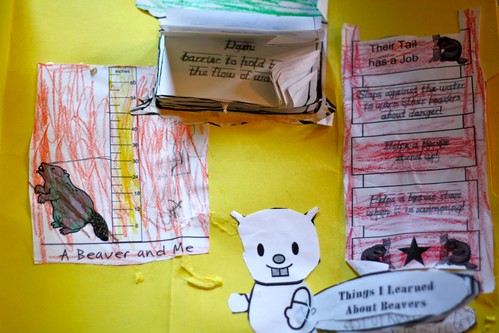
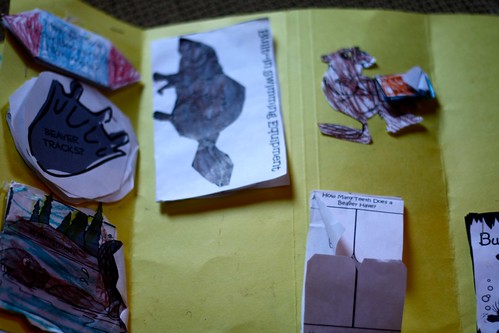
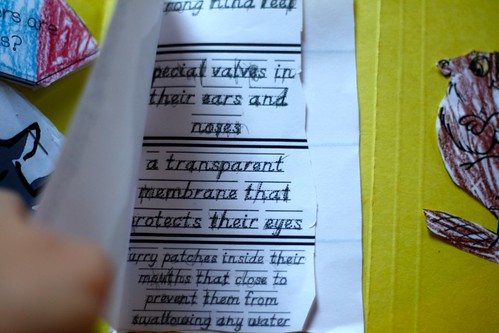
I'm sharing these photos after someone on a message board asked to see actual photos of lapbooks done by a K or 1st grader, without help really.  So many lapbooks I see online look so beautiful that I never posted pictures of ours because honestly .... they are not so beautiful except to their owners.  I aid in the learning of the material and what should be done, but I do zero of the cutting, folding, glueing, coloring or writing for my kids.  If they want to know how to spell something, I will write it on our whiteboard for them to copy, but they do the actual writing in their books.  So here is a "Busy as a Beaver" lapbook from Hands of a Child done by a 6yo boy, 1st grader, in the first semester of the year.  He struggles with fine motor (which, hey, you might have guessed looking at the photos).  However, he adored making this and learning more about beavers.  It was a great fit for his learning level, and the pack included either blank templates for the child to write in, or the ones we used where the child traced what was already written.  I love that it had adaptions for ability.

Wednesday, January 25, 2012

Book Review: The Long Way to a New Land


I don't use Sonlight as our primary curriculum any longer, but I continue to value and respect their reading choices. This one is a repeat for Zach and me, new to Noah and Lily. The Long Way to a New Land is of the series, "An I Can Read Book." On the back, suggested age is to 4 to 8, and I believe that is quite accurate, on the upper ages the child reading independently and on the lower ages as a read-aloud by the parent. The family in the book leaves a bleak existence in Sweden for new hope in America, based on a letter of encouragement from relatives who already had made the treacherous journey across the ocean. We follow the family through the journey, ending the book at arrival in the new land. For those interested, this family's saga continues in "The Long Way Westward." The pictures in Long Way to a New Land are dark blacks and grays, very little color, obviously suggesting the gray existence of the family. Unfortunately, it also means they are not easily seen, nor interesting, to the child reading the book or being read to. This is unfortunate, as it seemingly takes away some of the enjoyment of the book for the child, at least my children. I have used this twice now with 1st graders. The story itself is somber without being depressing, and interesting without being too long or detailed for a young child. I continue to think this is a good resource for the younger ones studying immigration to America during the early 19th century.

Tuesday, January 24, 2012

Book review: Cora Frear


This is used in Sonlight curriculum. It is a great fit for any US history/pioneer period study. I typically use it with my 1st grade kids, but my older and younger are interested too. Cora is a little girl who helps her dad, a doctor. On the way to a patient in their buggy, they get caught in a prairie fire. Cora is key in saving them, but I'll leave the rest a surprise. What is especially nice is this is based on a true figure in history, and of course female heroines are great as there are not quite so many books written starring a female for kids to admire. It is good for probably 2-3rd grade and above to read alone, or as a read-aloud down to even pre-K age.

Note it is part of the Brave Kids series, and we just put another of these on our library holds list as this one has been such a hit here.

Monday, January 23, 2012

Book Review: Dame Shirley and the Gold Rush


Although Dame Shirley and the Gold Rush has suggested age range of grades 3-6, I think it is suited towards slightly younger ages as well. The book is slim, only 4 chapters, making it a good choice for older struggling readers or reading aloud to younger readers with shorter attention spans. It gives a brief glimpse of life in the gold camps from the point of view of Dame Shirley, the wife of a doctor, as recollected through letters to her sister in the east. It is said those letters are the first truly honest written records of the gold camps. I used this book with 1st and 4th graders. We read it aloud over the course of a week. The language was simple, easily understood by both. There are a few black and white pictures to help the younger crowd. What this book provided that other resources did not interestingly was an introduction to the problem of racial tensions between the Hispanic and white miners during the time. Very little was mentioned about this in other books we read, but it features prominently in the camp described by Dame Shirley, causing her much distress. This gives a nice leap to talk about the history of these tensions throughout California history and into modern times. For such a short book, this is a very nice addition to our California study with grammar age students.

Friday, January 20, 2012

Book Review: Tales and Treasures of the California Gold Rush by Randall Reinstedt

Tales and Treasures of the California Gold Rush is an engaging book told in the first person narrative of the author, a storyteller. Chapters cover stories about the first gold discovered, how the 49ers arrived in California, famous and infamous bandits, what the 49ers did for fun and many, many tales of lost and buried loot from the mines, never found, to ignite the imaginations of the listeners of the tales. I read this book to my 1st and 4th graders in our California State study. Both were engaged in the lively tales, nearly always involving some sort of guns, hanging or a posse. So be forewarned, this book has quite a bit of death and burials, but not gory, and unavoidable given the subject matter. The early mining camps were not peaceful places. In terms of the kids' visualization of the time, place and people of the Gold Rush, this has far been their favorite resource this year. We very highly recommend it, both for the content and the easy narrative style of the storytelling, as either a read aloud selection or as a reader for older kids.

Tuesday, January 17, 2012

Book review: Jessie Benton Fremont: California Pioneer


This book is used as part of the Beautiful Feet California History Through Literature Guide. I used this primarily with my 4th grade son, with a 1st grader tagging along. Honestly, this book was a very difficult read, the hardest by far of the books used in the Beautiful Feet California History pack. My 4th grader is an accelerated learner, and he did okay, but he did not really enjoy this selection. I did not enjoy it either honestly. The vocabulary and syntax in the book were elegant, clearly a very literate and graceful writer. It was the actual plot that was uninteresting to us. The book covers almost the entirety of Jessie's life, yet I did not as a reader develop much empathy or interest in her fate. We are told time and time again in the book of her love of her life, her husband, so much so that this book could almost be considered a romance. The politics of the time, as they relate to our characters, are covered well, which is likely why this book is included in the history guide. We learn about topographical exploration of the west, slavery tensions in the government and among the states, the Mexican-American war, gold and mineral rights in California and the election of Abraham Lincoln through the historically-accurate interactions of the characters. Her children, her illnesses and her sadness are covered very dispassionately though, given she is the primary character. Perhaps this is because the author has her background in journalism rather than novels? The tone throughout is very dispassionate, which is disappointing as I think this was probably a very dynamic and interesting couple in history. Overall, I was extremely disappointed in this selection and will not read it again when I cover this time period later with my other children.