Showing posts with label science. Show all posts
Friday, September 12, 2014
As I mentioned, we are working on "notebooking" this year for science and history, more interactive way of taking notes and documenting. This is a picture Zach worked on from his Elemental Science Logic Stage Biology. We love Elemental Science. They provide nice student pages with space for notes and places or outlines of sketches. I had him copy the sketch into his laboratory notebook and then label and add color. Then, he did his laboratory writeup in the pages afterwards for the week instead of doing them in the student pages. We used the student pages last year, and they were certainly adequate, but with our focus this year I wanted more and chose to go this way. He continues to do his lab with a buddy each week, which adds some extra fun into his studies.
Monday, August 18, 2014
The Fall of Freddie the Leaf
We did a little more in Science Through Children's Literature today, this time talking about seasons and leaves falling, and read a book, The Fall of Freddie the Leaf. This was an incredible book for all of us, one I hadn't seen before today.


I can't say enough good about this book. The youngest got a little from it, but it really struck the 12yo.
Freddie is a leaf on a tree in a public space. He tells us about himself and his friends, the other leaves. He tells us about the spring and summer, the winds, the people who come to enjoy the shade. Then he starts to change colors in the fall, and tells us about that. He questions his wise friend, Daniel, another leaf, about what is next. Daniel explains to him that they are changing colors and that the leaves are dying and falling in the winter, but that it is okay, they are all part of Life. Freddie is frightened about dying, and Daniel reassures him and comforts him.
On the surface this book is about the seasons of the tree. But, of course, that is not all. This book is about Life and Death, passing from one season to another in a year and in life.
There are pictures of trees as the illustrations, a picture for most 2-page spreads but not every set. There is a paragraph or two for most 2-page spreads. This is a wonderful picture book for the elementary into middle school years really. It is a beautiful story for all ages.
I can't say enough good about this book. The youngest got a little from it, but it really struck the 12yo.
Freddie is a leaf on a tree in a public space. He tells us about himself and his friends, the other leaves. He tells us about the spring and summer, the winds, the people who come to enjoy the shade. Then he starts to change colors in the fall, and tells us about that. He questions his wise friend, Daniel, another leaf, about what is next. Daniel explains to him that they are changing colors and that the leaves are dying and falling in the winter, but that it is okay, they are all part of Life. Freddie is frightened about dying, and Daniel reassures him and comforts him.
On the surface this book is about the seasons of the tree. But, of course, that is not all. This book is about Life and Death, passing from one season to another in a year and in life.
There are pictures of trees as the illustrations, a picture for most 2-page spreads but not every set. There is a paragraph or two for most 2-page spreads. This is a wonderful picture book for the elementary into middle school years really. It is a beautiful story for all ages.
Tuesday, August 12, 2014
Science Through Children's Literature
We love teaching/learning through living books and always have. Below I talked about Art Through Children's Literature, and now I'll share some of what we are doing with Science Through Children's Literature. The science has two levels, beginning and intermediate. We are working on the beginning one with all, Zach for review, the rest maybe some new information.
Today, we talked about trees, using A Tree is Nice as the introduction story. Honestly, despite this being a Caldecott Winner, I wasn't terribly impressed with this book. The shape being tall and narrow like a tree was an interesting feature, and the illustrations (alternating color and pencil) were nice, but the vocabulary and sentence structure were bland to the extreme. It read like one of those tortuous level 1 readers kids try out when first learning to sound out words. Needless to say, my kids were a bit bored with this one.
We are notebooking this year though as our note taking activity, so we all then got out the science notebooks to write down something we learned. Lily made a beautiful picture to illustrate her coniferous/deciduous distinction in her notebook.
Today, we talked about trees, using A Tree is Nice as the introduction story. Honestly, despite this being a Caldecott Winner, I wasn't terribly impressed with this book. The shape being tall and narrow like a tree was an interesting feature, and the illustrations (alternating color and pencil) were nice, but the vocabulary and sentence structure were bland to the extreme. It read like one of those tortuous level 1 readers kids try out when first learning to sound out words. Needless to say, my kids were a bit bored with this one.
We are notebooking this year though as our note taking activity, so we all then got out the science notebooks to write down something we learned. Lily made a beautiful picture to illustrate her coniferous/deciduous distinction in her notebook.
Monday, February 03, 2014
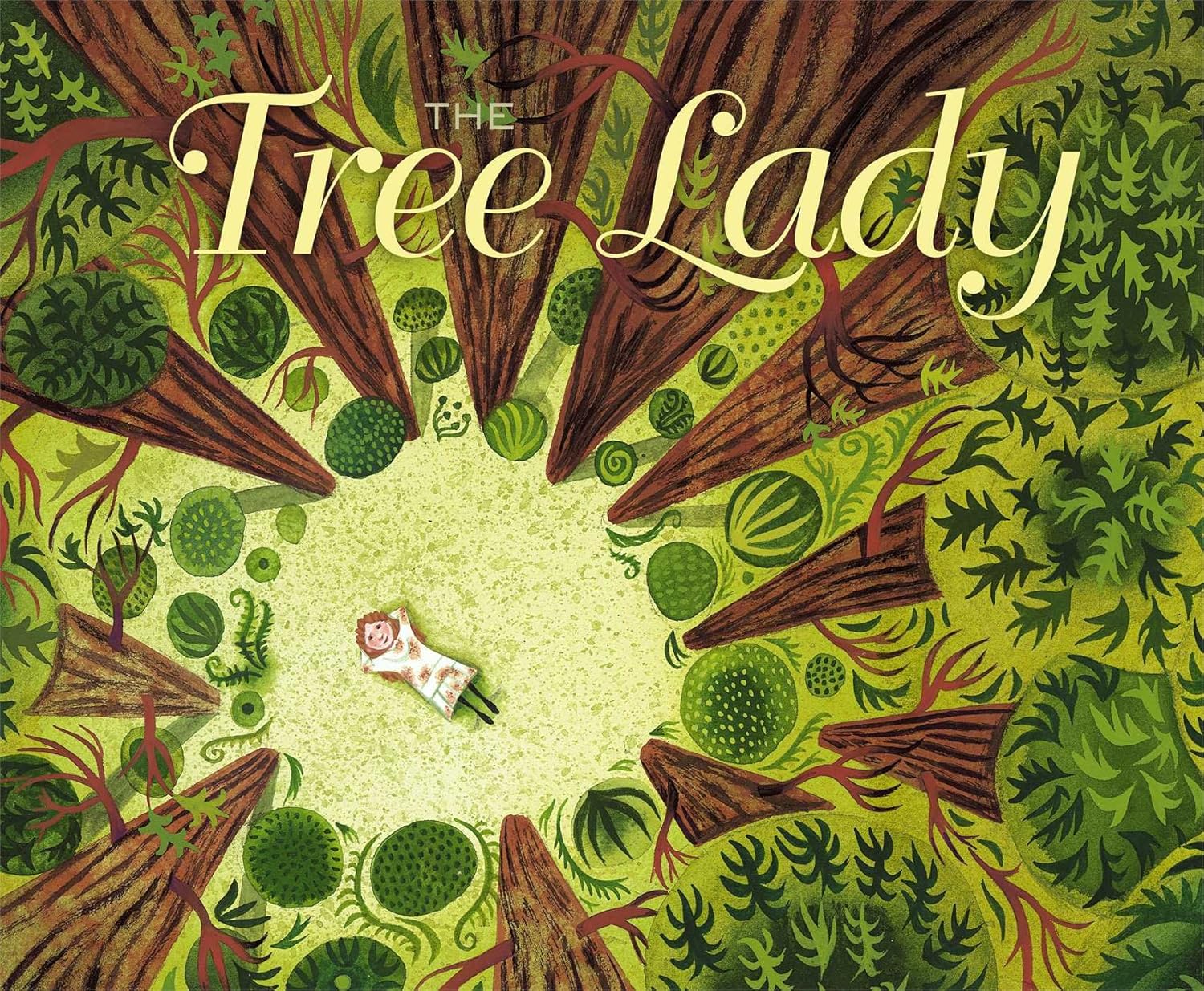
Book recommendation: The Tree Lady
The Tree Lady is a brief biography of Kate Sessions, a female teacher in the 1800s who had an interest in science and nature, unusual for the time period. This describes her education, move to San Diego and her subsequent search for trees that would grow well in this region, along with her influence of the tree planting of Balboa Park in time for the World Fair in San Diego.
The writing is all appropriate for preschool or early elementary age students, and the illustrations are just beautiful. This is a 5 star read for us, and especially applicable as it relates to our home city.
We used this as part of social studies as we live in San Diego. My kids were very interested as we live near a park named for her, as well as visiting Balboa Park often and appreciating the trees there. This was also wonderful from a science biography for younger kids as well.
Sunday, January 05, 2014
Butterflies!
As you know, we are privileged to have monarchs in our backyard each year. Our kids love hunting for and observing them throughout their lifecycle. Observing first hand has made them so appreciative of the miracle they are, and interested in learning more about them as they migrate. In addition to our observations, I pick up books for them to read about all topics, including butterflies. I happened across this new release pictured above, and wow, it is stunning. I highly recommend this one.
The picture comes from the author's website: http://www.loreeburns.com/
She has there not only the usual bio and other books listings, but a nice little teacher resource area as well.
Her photographs were by Ellen Harasimowicz. If you just want some eye candy, check out her site. So fabulous.
This book describes for kids the lifecycle of a butterfly while depicting a butterfly farm in Costa Rica.
The photographs in this book could honestly be framed and hung in a gallery. They are just incredible really. Any kid (or adult) with a love of nature would pour over this book again and again to see the photographs within. I can think of no other children's book recently with photographs nearly as nice as these.
The text? Well, it is just okay. There is not anything wrong with it, but it doesn't stand out to me either. And that is okay. It is factual and informative, but really is just backup to our star player the photography. This book is ideal for a kid who doesn't like reading I would think.
In addition to photography, there is a simple lifecycle of the butterfly diagram, a map and glossary, further reading recommendations and website. This is a gem for early elementary kids for sure. I give it 4 stars overall, 3 stars for the content of the text and 5+++++ stars for the photography in this one.
I received an electronic copy of this book via Netgalley for an honest review.
Friday, January 03, 2014
Nature Journaling
I purchased this book a little over a year ago now. After using and appreciating it, I wanted to review it a bit for those in need of a guide.
This guide shows how to create a gorgeous ongoing project of a nature journal. It is applicable to kids or adults, though kids might need a parent helper to read and interpret it all. Projects are given for a variety of ages or "all ages" depending on the project. No prior experience drawing is required. The examples given are inspirational without being overwhelming for those of us without a lot of native art talent. Most are shown black and white as would be common if you were out with just a pen and paper, but it also shows colored pencil or watercolor addition.
The book shows tons of examples in text and pictures how to add details such as dates, temperature conditions, scientific facts, etc., to your journal. The drawing techniques and examples could to be used to teach a child to enhance lab notebooks rather than a "journal" per se.
I use this with all my kids, and they are really taking to the idea, even now grabbing their journal without prompting to run into the yard to draw something. Nature journaling is helping them to be more aware in the world, and recognizing smaller details. Even my youngest (age 5/6 at the time of starting) is able to do basic drawings and observations.
There is a companion almost blank (few notes or hints) hardcover journal that you can buy to go with this guide that I highly recommend. The HC journal is tough and withstands kids very well.
Wednesday, December 18, 2013
And still more Greeks ....
Yeah, we're still studying Greeks. There is a TON to dig into during this period of course. In terms of all of us together, we read The Librarian Who Measured the Earth by Kathryn Lasky.
Kathryn Lasky is one of my favorite authors for kids, and this book did not disappoint. It is a nicely-illustrated biography picture book about Eratosthenes, the Greek who came up with a way to measure the circumference of the earth. It talks about his life, his intense curiosity about everything and finally the method he used to calculate the circumference of the earth (which was incredibly accurate by the way!). Given the content and calculations, even though it is a picture book, it suits upper elementary better than lower elementary students. My 6th grader liked it a lot even, and he rarely will admit to loving a picture book lately. My 1st grader liked the story okay, but the calculations of course were well beyond her understanding, even with the good pictures and descriptions. You really need basic geometry at 2nd or 3rd grade level to get much out of that part. What a fantastic book though, and a great addition to our ancient history studies this year.
Thursday, November 07, 2013
Onward to the rainforest
As I mentioned, Noah, Lily and I are working through Sassafras Science: Zoology as their main science this semester. The teacher's guide has added recommendations for living books, and today we got from the library one about the rainforest, which is the section we are just starting. Our add-on book today was We're Roaming the Rainforest:
I always like when one of our choices catches Eden's attention as well (age 3). This one was a nice easy intro with a group of children walking through the rainforest and encountering a few animals and lyrical verse. Each 2-page spread had great color illustrations for the youngest crowd (preschool-ish age). It was probably a little young for Noah, but hey all of us love a good picture book now and again. The back few pages though had some nice further information about the animals depicted, the rainforest as a whole, a nice map with simple detail level and brief words about a couple native tribes in the region and conservation concerns. Those few pages were beyond Eden for sure but the right level for a simple intro to further topics for the others. A great add-on choice as an intro for a unit on the rainforest for a multiple age grouping including preschool and grade school kids.
Zach is serving morning mass this week. My other grumpies make it not as possible each day to attend, so we wait in the van some days (like today). We took along our Sassfras and read the rainforest book while waiting. Eden then enjoyed paging through again to look at the great illustrations.
I always like when one of our choices catches Eden's attention as well (age 3). This one was a nice easy intro with a group of children walking through the rainforest and encountering a few animals and lyrical verse. Each 2-page spread had great color illustrations for the youngest crowd (preschool-ish age). It was probably a little young for Noah, but hey all of us love a good picture book now and again. The back few pages though had some nice further information about the animals depicted, the rainforest as a whole, a nice map with simple detail level and brief words about a couple native tribes in the region and conservation concerns. Those few pages were beyond Eden for sure but the right level for a simple intro to further topics for the others. A great add-on choice as an intro for a unit on the rainforest for a multiple age grouping including preschool and grade school kids.
Zach is serving morning mass this week. My other grumpies make it not as possible each day to attend, so we wait in the van some days (like today). We took along our Sassfras and read the rainforest book while waiting. Eden then enjoyed paging through again to look at the great illustrations.
Tuesday, November 05, 2013
Curriculum Review: Classroom Activities for the Busy Teacher EV3
In our 4-family little co-op this year, I am pleased to be teaching our older kids (5 boys) about some Lego EV3 programming and building. Two of those boys are also participating in our homeschool charter school's Lego team, so they are seeing the robots and programming at their weekly meeting and competitions as well. The other 3 boys have no other outside experience with the EV3 or Lego programming. This book by Damien Kee is a resource I saw on Amazon, and was immediately interested because as a busy mom I honestly wanted a structured framework for teaching EV3 but didn't want to create it myself. I have a background in programming, but EV3 is new to me, to give you an idea of my background coming into this.
Here are my impressions: I'm using this resource in a homeschool co-op environment with 5 boys ages 9-11. Each lesson in the book is designed to utilize about 5 hours of time. We don't have that much each week, so I split the lessons between weeks, and have the boys work on the student pages and programming at home in between sessions. It is taking us about 2 weeks per "week" of lessons. The boys are learning a lot, and the format of the lessons is easy for me as a parent teacher to utilize, even with limited EV3 background. There is a nice mix of theory and practice in the book to discuss, giving a great foundation. The math is manageable for the kids at the level I'm teaching with a little help here and there for those who hadn't encountered circumference or pi yet.
Saturday, August 24, 2013
Book review: Sorting by Lynn Peppas
This book is a "Correlated Reading" suggestion in Building Foundations of Scientific Understanding by Bernard Nebel (often referred to as BFSU), lesson A1. That is how we came to be reading it. ;)
Packed with an incredible introduction to mathematical concepts in a short 24 pages, but it felt rushed and the pictures were very blah and uninspired. Are there no better things to sort than socks? Maybe some colorful birds or something a little more interesting?
There is nothing inaccurate on the definitions or descriptions, but there is nothing outstanding about this book either. I choose and read science and math picture books to my kids to give that something "extra" to inspire an interest in what can be a dry topic (thinking math here for kids). This book just didn't fit my requirements, too dull and unimaginative really.
Friday, August 23, 2013
Book review: Chee-Lin: A Giraffe's Journey by James Rumford
This is the tale of Tweega (Swahili for "giraffe") and his journey from his home in Africa, captured and taken across the continents, ending finally in Peking more than 20 years later. Along the way, Tweega meets different people and experiences new things.
What is unique and wonderful about this book is not the plot as it is, but the beautiful lyrical language and gorgeous illustrations. This book really was a treat to read aloud and look at with my kids. It is quite long for a picture book, and is best probably broken up over several days or more. Each 2-page spread really serves as a chapter or section, and can be broken up that way.
The first pages tell of what a chee-lin is (mythological horned beast) and an omen of good fortune to the Chinese.
If you read this, notice at the back the nice map of the world highlighting Tweega's travels. I wish I had noted this first so we could have referenced it during the story.
This book is definitely a 5-star read, not to be missed.
Side note: We read this as a recommendation/extra reading living book in our science curriculum for my 1st and 3rd grade kids. We are using Sassafras Science Adventures: Zoology with them right now, which is also a "living book" rather than a textbook as we follow twin children in discovery of animals around the world. Chee-Lin was recommended in the giraffe section, and I'm so glad we didn't miss this one. :)
Subscribe to:
Posts (Atom)